
No later design carries the same historical gravity.
Issuing the Flowing Hair Dollar marked the actual beginning of the operation of the United States monetary system.
Implementing the provisions of the Coinage Act of 1792 required creating a domestic currency to ensure economic independence.
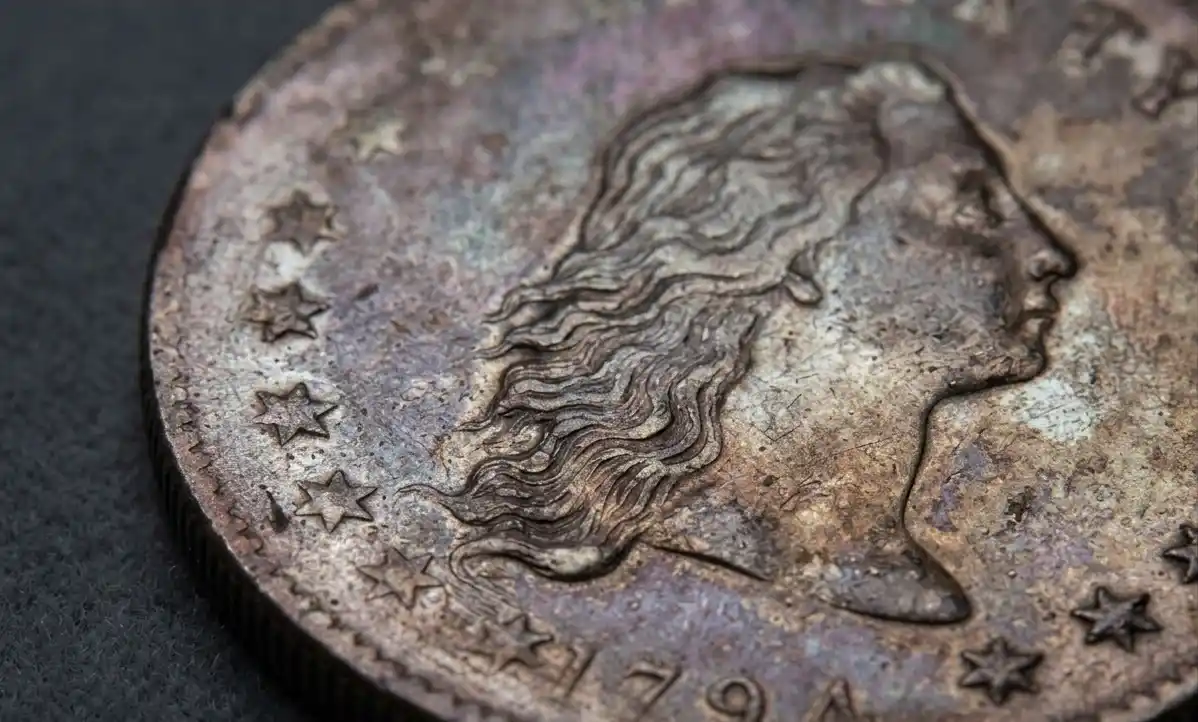
First specimens emerged from the minting press in October 1794.
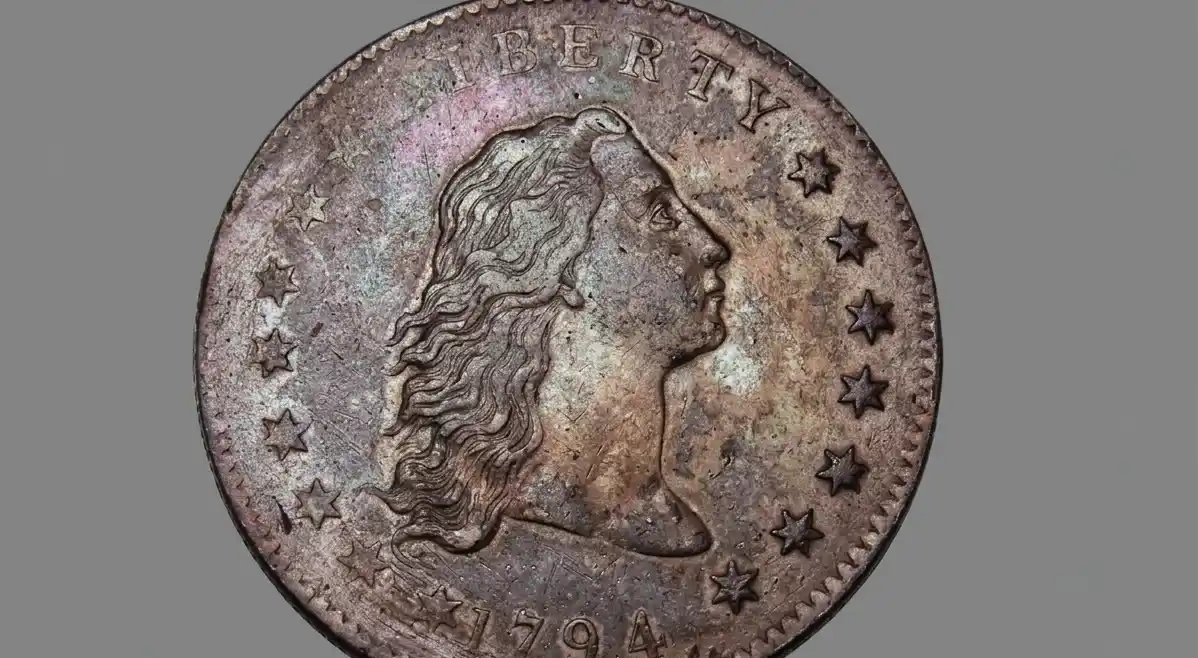
Designed by Robert Scot, the imagery reflected the ideals of a young republic through Liberty with flowing hair.
Characteristic
Value
Metal Composition
89.24% Silver, 10.76% Copper
Total Mass
26.96 grams
Diameter
39.5 millimeters
Edge Type
Lettered Dollar Seceit And A Half Disme
1794 Mintage
1,758 pieces
1795 Mintage
160,295 pieces
Deviations in weight exceeding 0.5 grams usually indicate significant wear or a counterfeit.
Adding copper as an alloy provided the necessary hardness for the silver mixture.
Obverse and Reverse Sides
Occupying the central position on the obverse, the bust of Liberty faces right.
The word LIBERTY sits along the upper edge.
Fifteen stars placed on the sides represent the number of states ratifying the Constitution at the time of issue.
The reverse contains an image of a bald eagle inside a laurel wreath.
Omitting the denomination from the coin surface was compensated for by the edge lettering.
Striking by hand ensured the uniqueness of every individual die used.
Auction Records and Investment Value
The 2026 market shows a steady increase in interest regarding proven assets.
One specimen in SP66 condition set an absolute price record.
Price dynamics for high-grade samples:
2013 — $10,016,875
2022 — $12,000,000
2026 — $13,450,000
Average annual growth stays around 3.5% for rare categories.
→ Reducing volatility during long-term holding
→ Rising demand amid a shortage of supply
→ Strengthening the coin’s status as a cultural artifact
Owning such a coin guarantees capital preservation under inflation conditions.
Wear Factors and Grading Classification
Professional assessment based on the Sheldon scale determines the final lot price.
Most 1794 coins possess a grade below VF20.
Determining the detail level of the Liberty hair
Analyzing the preservation of feathers on the eagle wings
Checking for the presence of original mint luster
Simply using the free coin appraisal app
Weak striking often gets mistaken by inexperienced researchers for natural wear.
Having adjustment marks, representing file traces used to correct the weight, does not count as a defect.
Comparative Analysis of 1794 and 1795 Mintages
Difference in production volumes defines the availability of coins on the market.
Year of Issue
Estimated Survivors
2026 Starting Price
1794
~130 pieces
$285,000
1795
~3,500 pieces
$4,500
1795 coins feature two main reverse design types.
The first type differs by having two leaves under the eagle wings.
Containing three leaves, the second type remains more common.
Value for rare 1795 varieties exceeds base prices by 3 times.
Impact of the Silver Standard on the Economy
Introducing the Flowing Hair dollar allowed for displacing foreign currency from circulation.
Before this moment, the Spanish dollar held a dominant position.
Domestic silver production provided stability for internal settlements.
The government aimed to establish a fixed ratio of gold to silver.
A 1 to 15 proportion became the foundation of bimetallism in the USA.
Abandoning the Flowing Hair design at the end of 1795 resulted from criticism regarding the bird appearance on the reverse.
Technological Aspects of Verification
Modern verification methods include laser scanning of the surface.
This technology allows for identifying microscopic changes in the metal structure.
Researching the chemical makeup confirms the authenticity of the late 18th-century alloy.
Lacking modern impurities like aluminum or nickel serves as proof of authenticity.
X-ray analysis is performed without damaging the patina.
Market Condition and Expert Forecasts
Investment in American numismatics shows resilience against market shocks.
The share of Flowing Hair coins in large fund portfolios grew by 12% over the last two years.
Factors influencing the price in 2026:
Provenance transparency
Certification by leading agencies
History of participation in major collections
Transactions involving specimens priced above $500,000 are now recorded in blockchain registries.
This step excludes the risk of purchasing stolen or counterfeit assets.
Storage and Conservation Features
Silver actively reacts with sulfur in the surrounding air.
Developing a dark patina is considered a natural process.
Removing patina via chemical methods reduces the coin value by 50% or more.
Recommended environmental parameters:
→ Temperature 18-22 degrees Celsius
→ Humidity no more than 30%
→ Using inert polymer capsules
Mechanical impact on the edge is unacceptable during any handling.
Influence on Subsequent Issues
The Draped Bust design, replacing the original, retained some elements of the predecessor.
However, Flowing Hair remains the symbol of the initial vision of American freedom.
The coin served as a prototype for many commemorative issues in the 20th century.
In 2024, the US Mint released a gold replica, highlighting the significance of the original.
This event caused a surge of interest in the 1794 authentic pieces.
Legal Status and International Transport
Flowing Hair coins are recognized as national treasures of the United States.
Moving these across borders requires special declaration.
Insuring lots during transport costs 0.8% of the appraised value.
Ownership is confirmed by an auction invoice or a certificate of inheritance.
In 2026, rules for checking the source of funds when purchasing such assets became stricter.
Certification and Grading Process
Sending a coin for evaluation involves the risk of damage in transit.
Professional dealers utilize armored courier delivery services.
Evaluation takes from 30 to 90 days depending on the selected tier.
Obtaining a Mint State grade for the 1794 issue is practically impossible.
Any specimen in MS condition immediately becomes a global sensation.
Rarity of Specific Die Marriages
Numismatists identify about ten different die pairs for the 1795 year.
Some of these are known in quantities of fewer than five pieces.
Studying die defects allows for tracing the chronology of the mintage run.
Gradual deterioration of the die metal leaves characteristic marks on the coin field.
These signs are used by experts to identify artificially aged copies.
Modern Collecting Trends
In 2026, a transition from quantitative to qualitative collection building is observed.
Owners prefer one Flowing Hair coin over ten ordinary Morgan dollars.
Rising prestige of owning the first US issues stimulates competition at auctions.
Auctions in New York and Las Vegas attract a record number of online participants.
Using augmented reality allows for detailed study of the coin before bidding starts.
Analysis of Edge Preservation
Lettering on the edge was applied before the main striking using a Castaing machine.
This device pressed letters into the rim of the blank disk.
The condition of the lettering is critical for determining authenticity.
Letters must be sharp and evenly distributed around the circumference.
Traces of filing on the edge often indicate an attempt to hide counterfeit signs.
Impact of Lighting on Visual Assessment
Proper light and the free coin value lookup app reveals hidden scratches and cleaning marks.
Using lamps with a color temperature of 5000 Kelvin is the standard.
In 2026, digital light meters will be applied to evaluate the luster.
An objective indicator of reflective ability is entered into the coin certificate.
This prevents manipulation with photos in sales listings.